

BJJ Belts in Order: Jiu-Jitsu Belt Ranks, Stripes & Requirements
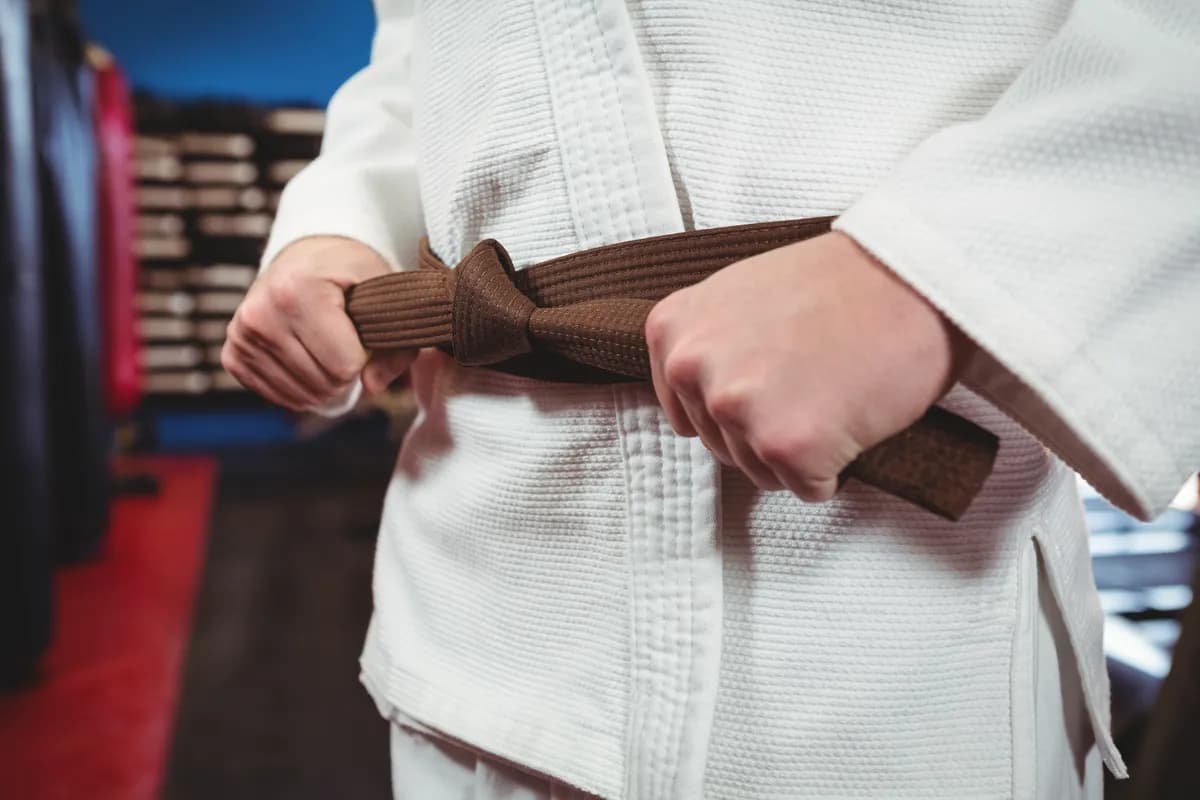
The BJJ belt order for adults is white, blue, purple, brown and black — followed by the red/black and red/white coral belts and, at the very top, the red belt. Getting to black belt usually takes 8–12 years, because promotions are earned through skill and mat time rather than a fixed schedule. This guide covers every rank in the jiu-jitsu belt order, what the stripes mean, the IBJJF minimum requirements, and realistic timelines for each belt.
The Adult Belt Order in BJJ
The adult belt system (16 and older) consists of five main belts:
After black belt, there are additional degrees and higher ranks — red/black coral belt, red/white coral belt, and red belt — but these are reserved for those who have dedicated decades to the art.
Each belt from white through brown has four stripes that mark progression before the next promotion. A stripe is typically a piece of white tape applied to the belt, though academies vary.
IBJJF Minimum Requirements at a Glance
| Belt | Min Age | Min Time at Belt | Typical Time to Next Belt |
|---|---|---|---|
| ⚪ White | — | — | 1–2 years |
| 🔵 Blue | 16 | 2 years | 2–4 years |
| 🟣 Purple | 16 | 1.5 years | 1.5–3 years |
| 🟤 Brown | 18 | 1 year | 1–2 years |
| ⚫ Black | 19 | — | — |
These are IBJJF minimums — most practitioners take longer at each rank, and many academies operate independently of IBJJF rules. For the full official document, see the IBJJF Graduation System.
White Belt
The starting point for every BJJ practitioner. White belt is where you learn to survive, understand positions, and build the foundational movement patterns that everything else builds on.
Realistic duration: 1–2 years before blue belt, though this varies widely. Some dedicated competitors progress in under a year; others spend three or more years at white belt by choice or circumstance.
What you're learning: escapes, basic guard passing, mount, back control, the rear naked choke, armbar, triangle, and how to fall safely.
There are no formal requirements at most academies — your instructor decides when you're ready based on overall development.
Blue Belt
Blue belt is the first major milestone and often the hardest to reach. It signals that you have a working game, can hold your own against other beginners, and understand the fundamental positions.
Realistic duration: 2–4 years to reach purple belt. The IBJJF requires a minimum age of 16 and at least two years at blue belt before promotion.
What you're developing: a preferred guard style, a basic passing game, a submission chain, and the ability to link positions together with intent.
Blue belt is also famous for the highest dropout rate in BJJ — many people quit around this stage, which is sometimes called the "blue belt blues." For a detailed timeline, see how long it takes to get a blue belt.
Purple Belt
Purple belt marks the transition from student to emerging instructor. At purple, you're expected to have a personal game with genuine strengths, the ability to teach basics, and a growing understanding of strategy and transitions.
Realistic duration: 1.5–3 years before brown belt. IBJJF minimum age is 16, with at least 1.5 years at purple required.
What defines this rank: technical depth over breadth. Purple belts typically specialize — leg locks, guard retention, pressure passing — rather than trying to do everything.
Brown Belt
Brown belt is refinement. The major technical questions are largely answered; the work now is about sharpening details, eliminating weaknesses, and developing the teaching ability expected of a black belt.
Realistic duration: 1–2 years before black belt. IBJJF requires a minimum age of 18 and at least one year at brown.
Many describe brown belt as the most rewarding stage — you're skilled enough to explore freely but still have clear room to grow.
Black Belt
Black belt in BJJ is a genuine milestone that typically takes 8–12 years of consistent training for most adults. It is not a sign that you have mastered the art — it means you have a deep, functional understanding and the ability to continue growing independently.
IBJJF minimum age: 19 (18 for an Adult World Champion at brown belt). Minimum time at brown belt: 1 year.
Black belts have degrees (1st through 6th) under the IBJJF system, though the time between degrees is not uniform:
- 1st degree: 3 years after black belt promotion
- 2nd degree: 3 years after 1st degree
- 3rd degree: 3 years after 2nd degree
- 4th degree: 5 years after 3rd degree
- 5th degree: 5 years after 4th degree
- 6th degree: 5 years after 5th degree
Many practitioners follow their instructor's system instead of the IBJJF timeline. For a realistic breakdown of the journey, see how long it takes to get a black belt in BJJ.
Higher Ranks: Coral and Red Belt
These ranks are reserved for those who have spent their lives contributing to BJJ:
- 7th degree (red/black coral belt): minimum age 49, after 31 years as a black belt
- 8th degree (red/white coral belt): minimum age 56, after 7 years at red/black
- 9th degree (red belt): minimum age 66, after 10 years at red/white
- 10th degree (red belt): given only to the five pioneers: Carlos, Oswaldo, George, Gastão and Hélio Gracie
The red belt is the highest rank in BJJ and has been awarded to only a few dozen people in its history. Learn more about what the coral belt is and who holds it.
What Are Stripes?
Stripes are intermediate markers between belts. Each belt from white to brown has four stripes. They are:
- Not standardized — each academy awards them differently
- A useful motivational tool during the long gaps between belt promotions
- Not required for promotion; an instructor can skip directly to the next belt
Some academies use a formal curriculum tied to each stripe; others award them purely at instructor discretion.
How Long Does It Take to Get a Black Belt in BJJ?
The average is 8–12 years for adults who train consistently (3–5 times per week). The IBJJF enforces minimum time requirements at each belt, meaning the fastest possible path under their rules is approximately 5–6 years — but this is extremely rare and reserved for elite competitors.
Factors that accelerate progression:
- Training frequency and consistency
- Competition experience
- Quality of instruction and training partners
- Prior grappling background (wrestling, judo, sambo)
Kids and Teens: A Different System
Practitioners under 16 follow a separate belt system with additional ranks including grey, yellow, orange, and green belts. These are not part of the adult system and do not transfer directly — a green belt teen typically receives a white or blue belt when they transition to adult classes, depending on their skill level.
Frequently Asked Questions
What is the belt order in BJJ?
The adult BJJ belt order is white, blue, purple, brown and black. After black belt come the degree ranks: red/black coral belt (7th degree), red/white coral belt (8th degree) and red belt (9th and 10th degree). Kids under 16 use a separate order: white, grey, yellow, orange and green.
What is the highest belt in BJJ?
The red belt (9th and 10th degree) is the highest rank in Brazilian Jiu-Jitsu. Under IBJJF rules the 9th degree requires a minimum age of 66 and decades as a black belt, so it has only been awarded to a small number of pioneers who spent their lives developing the art. The 10th degree was given only to the five Gracie brothers who founded the art.
How many stripes are there before the next belt?
Each belt from white to brown has four stripes. Once you receive your 4th stripe, you are eligible for promotion to the next belt — though your instructor may promote you at any point, with or without completing all stripes.
Can you skip belts in BJJ?
Yes, instructors can skip stripes or even entire belts if they feel a student's level warrants it. It is rare but not unheard of, particularly for athletes with a strong grappling background (wrestling, judo, sambo).
What is the minimum age for a BJJ black belt?
The IBJJF requires a minimum age of 19 for black belt promotion. Since 2026 the one exception is an Adult World Champion at brown belt, who can be promoted at 18. Outside IBJJF there is no universal rule, but 19 is the widely accepted standard.
Does competing help you get promoted faster?
Yes. Competition experience is one of the most consistent factors instructors consider when evaluating readiness for promotion. It tests your game under pressure in a way that academy training alone cannot replicate.
What is the fastest possible path to black belt?
Under IBJJF rules, the absolute minimum is approximately 5–6 years. In practice, this is extremely rare and reserved for elite competitors. The realistic average is 8–12 years of consistent training.
What is sandbagging in BJJ?
Sandbagging refers to a practitioner competing at a belt level below their actual skill — either by delaying their own promotion or by exploiting loose promotion standards across academies. It is widely considered unsportsmanlike. Some federations, including the IBJJF, enforce minimum time requirements partly to curb this, and competitors can be flagged or disqualified if officials determine their level is inconsistent with their registered belt.
How are BJJ belt promotions decided?
There is no universal curriculum. Most instructors evaluate a combination of technical skill, mat time, attitude, teaching ability, and competition results. Some academies use a formal syllabus tied to each stripe; others rely entirely on instructor discretion.
Key Takeaways
The BJJ belt system rewards long-term commitment over short-term achievement. Promotions can feel slow — especially between blue and purple, which is often the longest gap — but this is intentional. The goal is not to collect belts; it is to build a level of skill that genuinely reflects each rank.
One of the best ways to accelerate your growth and show your instructor you are ready is to compete. Find upcoming BJJ competitions near you and start putting your game to the test.